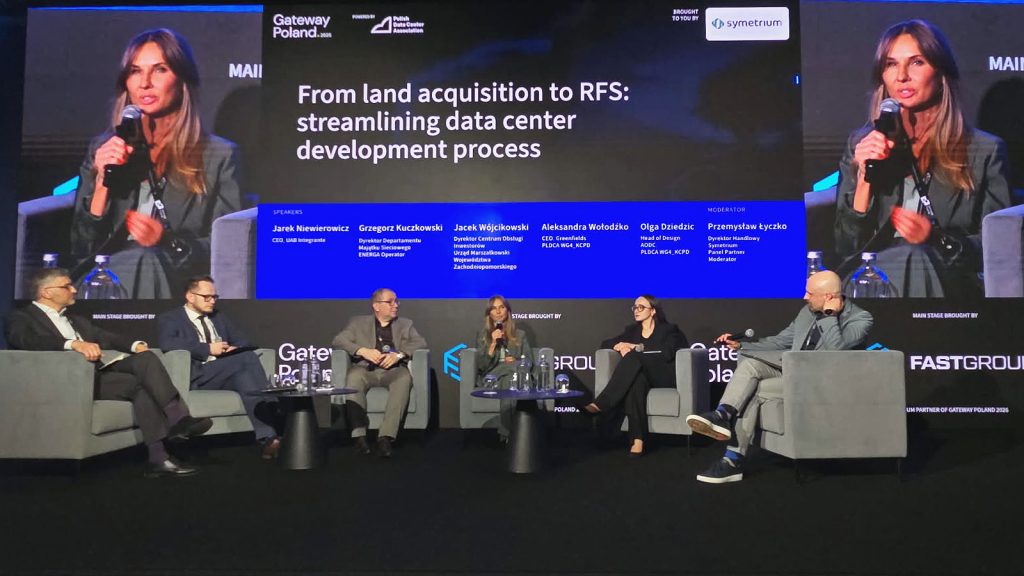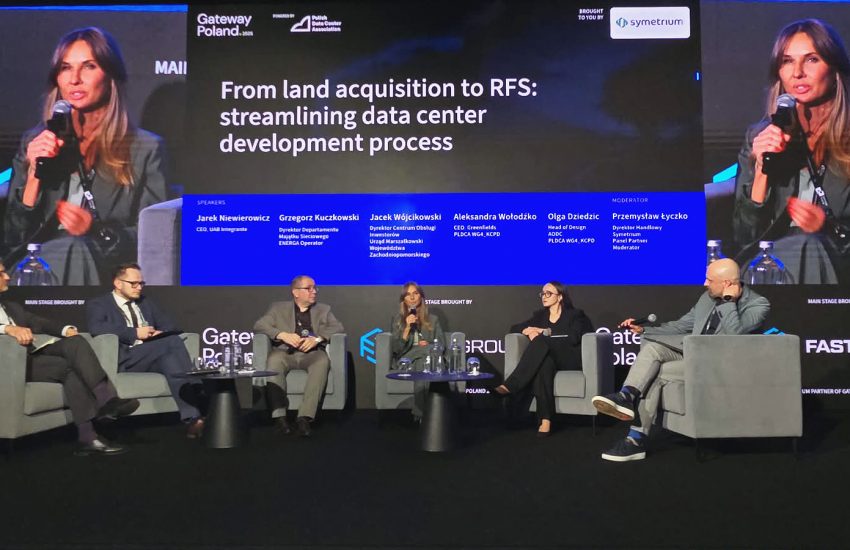
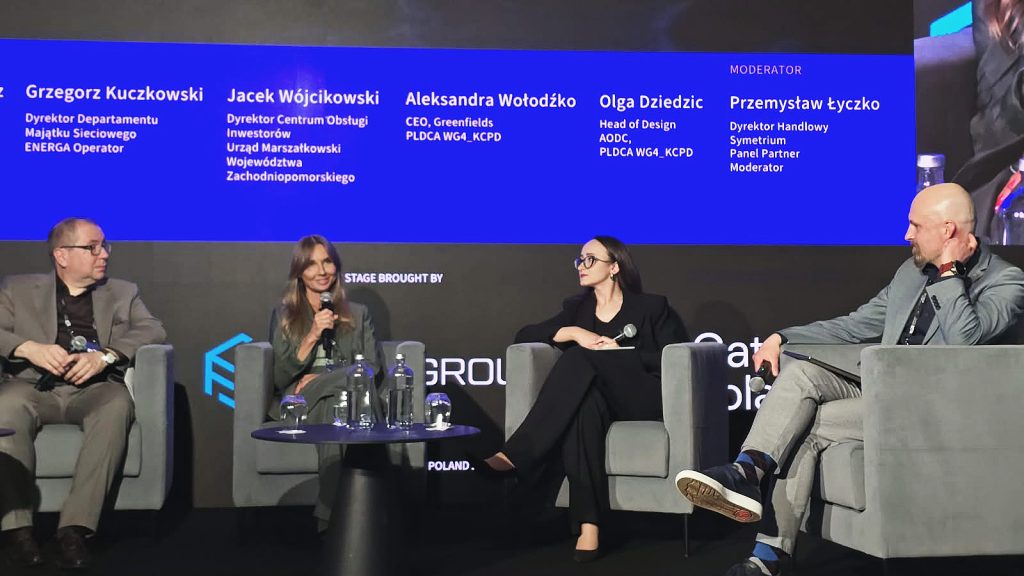
Nor will I dwell on how brilliant my fellow panelists and the moderator of the discussion titled “From Land Acquisition to RFS: Streamlining the Delivery Process for Data Center Projects” were – although they absolutely were. Przemysław Łyczko, Olga Dziedzic, Grzegorz Kuczkowski, Jarek Niewierowicz, Jacek Wójcikowski
Instead, I would like to share with you – especially with those who could not join us – the substantive takeaways themselves, because that is exactly why we meet at events like this: to discuss what truly matters, exchange practical experience, and take away something genuinely valuable from these conversations.
1. The panel centered on a report on administrative barriers to Data Center investments in Poland. The average investment process takes 49 months, with nearly half of that time consumed by administrative procedures, while the rest depends on the investor. The panelists emphasized that time has become the key issue, and that shortening it was one of the main goals of the report. The report will be published soon.
2. The report’s main objective is to shorten the investment delivery timeline. A broad group of around 30 people from multiple companies worked on the material. I am particularly proud that the Greenfields team of experts was deeply involved in preparing this report. The authors and panelists stressed that the aim is not to waive requirements or lower standards, but to streamline procedures. The report is intended to help identify what slows projects down the most and where changes can be introduced. The PLDCA working group developed 14 priorities and around 30 solutions considered significant – some of which could be included in a future “DC Act,” while others could be implemented even earlier.
3. The biggest barriers concern environmental issues, grid connections, and spatial planning. The discussion repeatedly returned to environmental decisions, grid connection conditions, and interpretation problems related to local zoning plans and general plans. Other related procedures were also mentioned – and there are quite a few of them — which further complicate the process.
4. In the area of land and real estate, the complexity of the acquisition process itself is a major issue. A plot that meets the basic criteria often consists of multiple parcels and multiple owners, which in itself complicates the investment and requires lengthy negotiations. In addition to formal matters, there is also a relational and psychological factor – some owners hesitate or are unwilling to discuss a sale.
5. Public administration does not always have sufficient experience in assessing such investments. The Data Center function is still relatively new, which means that interpretation difficulties sometimes arise on the side of public authorities. Such a function may fit within provisions concerning warehousing, services, production, or industrial use, and the report will be helpful as interpretative guidance for offices and authorities.
6. Connection conditions and capacity blocking remain a major challenge. Around 90% of applications for Data Center grid connection conditions were approved, but much depends on the gap between available and required capacity. The issue is not only the procedures themselves, but also the phenomenon of capacity being reserved by entities that do not necessarily go on to implement projects. Planned legal changes are intended to limit such practices and favor those who are actually advancing real investments.
7. Transparency regarding available power capacity should help investors make better decisions. Previously, the relatively low entry threshold allowed large amounts of capacity to be reserved with limited commitment. After the changes, connection conditions are to remain valid for a shorter period, the entry threshold is to be higher, and priority is to be given to those who move more quickly into actual investment activity. A publicly available map showing energy resources, grid connection possibilities, and how much “green energy” is available in a given area is expected to help investors choose locations more effectively and avoid the cost of filing applications in places with little chance of success.
8. The potential of Western Pomerania – a location outside the largest urban hubs. Director Jacek Wójcikowski spoke about assessing the region as a potential location for new Data Centers. He highlighted, among other things, a significant surplus of renewable energy and pointed to post-industrial areas and technology park zones as potentially attractive sites for such investments.
9. A strong call emerged for a special fast-track path for large projects. The discussion included the idea that, for large-scale investments, an “integrator” should guide the investor through the process and coordinate all permits on the state side. The speakers emphasized that for investors, the “cost of waiting” and the “cost of uncertainty” are becoming more important than the price of land or energy alone. At the same time, they noted that today there is a lack of real decision-making power on the side of institutions meant to support investors. Examples were given of past and present investor service centers, which help thanks to relationships and cooperation, but do not have sufficient formal authority. Without formal empowerment and a duty to act, administrative goodwill alone is not enough to accelerate the process effectively.
10. Lithuanian and Baltic solutions as a reference point. In the discussion, Jarek Niewierowicz compared the Polish model with solutions in Lithuania, where large projects benefit from more centralized pathways, coordination, and administrative support. He also stressed that in projects like these, the decisive factor is not only economic incentives, but also the speed, clarity, and predictability of decisions. He cited examples of thresholds and criteria – investment size, number of jobs created, and project status – that determine whether a project can receive official support. What matters here is the mechanism itself: once certain conditions are met, the investor moves onto a faster and more structured path.
Lithuania benefits from a relatively strong and accessible grid and a rapidly expanding renewable energy sector, which supports this type of investment. A new approach was also mentioned, under which a state-owned energy company would take a more active role in looking for ways to support Data Center investments – is that the right direction? Time will tell.
11. The possibility of using legislative solutions known from other sectors. We compared Data Center sector regulations with special-purpose acts and with the experience of “lex developer” provisions, as examples of instruments that can simplify procedures for specific types of projects. At the same time, the speakers stressed that the report does not limit itself to calling for a single act, but proposes a more comprehensive approach. Some solutions would require statutory changes, while others could be introduced more quickly at the level of secondary legislation. Not all changes require a lengthy legislative process.
12. In the transactional sphere, the expectations of landowners and investors must be reconciled. On the one hand, landowners want a quick sale, especially when a property is already covered by a zoning plan. On the other hand, investors try to minimize risk as much as possible, which lengthens conditions precedent and can weaken the momentum of negotiations. At Greenfields, we examine real estate in a multidisciplinary way – from the perspective of energy, environmental, and planning issues – but it is not possible to eliminate all risks at the outset. What is needed here is balance and greater flexibility on the investor side.
13. The importance of social communication. Even if an investment successfully passes through formal procedures, it may still face broad public opposition. That is why education, communication, and building understanding around such investments were identified as a very important part of the overall process.
Thank you to the organizers for their trust and for inviting me to the conference. I hope this discussion will continue at future Data Center conferences.