



fot. Greenfields
The opening speech strongly conveyed the idea that faith in the durability of the existing order is coming to an end: faith in security understood as something obvious, in globalization as an irreversible process, and in the stability of supply chains on which we based our economic development. We observe current events, often hoping that after the next turning point “something will change”. Meanwhile, the truth is that this world has already changed. And it has changed permanently.
Today, energy, production, proprietary technologies, industry, logistics, airports, railway hubs and defence policy are no longer purely economic topics. They are assets that demonstrate the strength of an economy, the resilience of a state and real sovereignty. They cannot be built with declarations. They require real money, real decisions and real solutions.
We need acceleration. We must abandon some of our previous assumptions, look more boldly at new solutions and make decisions faster. Because competitiveness will not wait until we get through another procedure, another stage of consultations or another regulatory uncertainty.
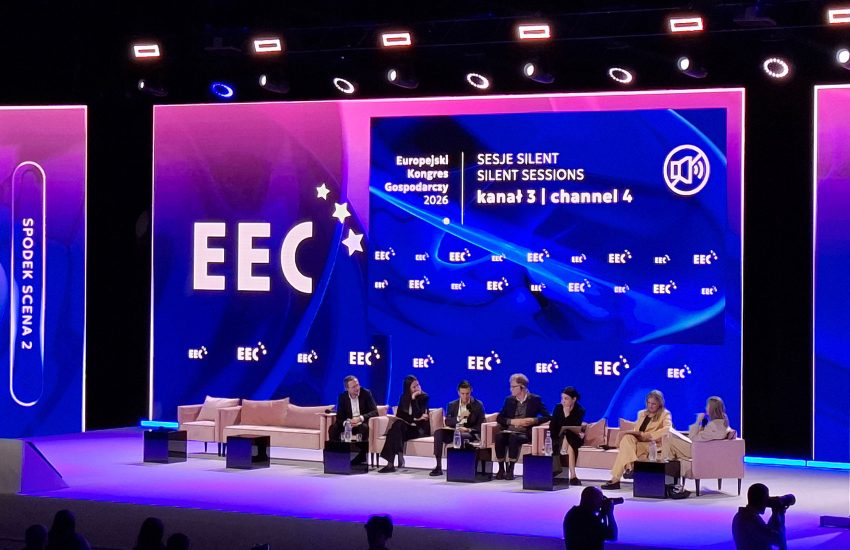
The conference theme, “The Power of Dialog”, fit this context very well, because it is precisely the power of dialogue that changes the world. And Katowice, which every year hosts politicians, local government representatives, business, academia and the technology sector, is becoming one of the best examples of transformation happening before our eyes.

fot. Greenfields

fot. Greenfields
One of the strongest questions that kept coming back in the speeches and discussions was whether energy and raw materials are still purely market issues, or whether they have already become political tools. The answer seems increasingly obvious. We must be prepared not only for the scenarios we expect, but also for the unexpected – and for what may affect each and every one of us.
The motif of the heart also appeared in several speeches. Because at the heart of every process is the human being. Technological, energy and digital transformation do not happen in isolation from people. It is also we – as users, customers, residents and citizens – who, through the way we use technology, energy and infrastructure, influence the security of our country.
We are entering a stage of deglobalization. The European Union must have its own products, its own industry, its own energy and its own technologies. Anyone who locates investments, production or services outside Europe must take into account unpredictable events, supply chain disruptions and risks that only a few years ago seemed abstract
And in this context, it becomes even clearer how much we need smart regulation. Meanwhile, many legislative ideas that sound brilliant in theory increasingly resemble solutions taken from a centrally planned economy. It was supposed to be smart, but too often it turns into procedural torment. Business operates on the basis of efficiency – which, unfortunately, is often hard to find in many existing and proposed regulations.
What needs to happen for things to improve?
We must focus on “Brand Poland” and “Brand Entrepreneur”. Entrepreneurs are responsible for a huge share of Poland’s GDP and it is they who face, every day, the practical consequences of overregulation, uncertainty and lack of predictability. The paradox is that although we live in an increasingly better infrastructural and technological environment, we are becoming less and less competitive.

fot. Greenfields
The subsequent panel discussions only confirmed these main theses.
In the panels closest to our areas of interest, the role of data centers resonated particularly strongly. For Poland, this is still a business that is only emerging and still building its position. Today, around 2% of the European data center market is located in Poland. DATA4’s ambition is to increase this share to 6% by 2030, which, on a European scale, would position us between Italy and Spain.
Poland matters for several reasons. We are the largest country in Central and Eastern Europe. Competence centers are being built here. Geographically, we are a gateway both to the East – towards Asia – and to the West – towards Western Europe. This location can be our advantage, but only if we are able to use it.
PLDCA, working with public administration and local governments, is trying to develop solutions for an industry that will continue to grow. Because every investor coming to Poland with a data center project first asks a very specific question: how much energy can we deliver, of what quality, and at what price?
Without an answer to this question, it is difficult to speak about Poland’s real competitiveness in the data center market
In recent weeks, another Atman data center was opened in Duchnice – with representatives of public administration attending the event – which also shows that digital transformation is becoming one of the key topics in the country’s development.
Another separate and very important thread was the AI gigafactory in Poland. Just a few years ago, such projects might have seemed like a vague vision. Today, we are already discussing what actually follows from earlier announcements and what decisions need to be made so that Poland does not remain merely an observer of this change.
The Baltic AI Gigafactory project is still ongoing, although at the end of 2025 the conditions and rules on the European Commission’s side changed, which complicated its further implementation. Applications are being submitted to amend the rules, and the process is slowly being delayed. We are talking about a project worth around EUR 3 billion, initially assuming around 100,000 GPUs and a power demand of approximately 100–200 MW.
This is a business project in which around 17% of the financing would come from the Polish state, up to 17% from the European Commission, and the remaining 70–75% from business and the consortium. For comparison, several such consortia operate in Germany, and similarly in France. Talks in Poland are ongoing, and a tender is expected in the near future.
The key question is: will the Polish state provide its share of the financing? There are also questions about the scaling of the project, the real demand and its structure. A distributed model is being considered, covering Poland, Czechia and Lithuania, connected by a high-speed network.
Is there demand for such computing power? Of course there is. The problem is rather that while we are still analyzing, meeting and building yet more working groups, others are implementing investments on a massive scale at the same time. Americans are able, in a similar period, to build data centers with a capacity of 1–2 GW and launch another 16 halls, while we are still at the stage of arrangements and analysis.
In this context, the example of the third, private AI factory being developed by Beyond.pl also sounded particularly interesting. It is a very important signal from the market: business cannot wait until all legislative and administrative processes mature at their own pace. Infrastructure for AI is becoming an essential element of the economy of the future and must be built now.

fot. Greenfields
The representative of Beyond.pl emphasized that the company cannot afford to wait passively, because the whole world is investing in this type of resource today. The scale of market demand is so large that it exceeds the capacity of individual investments. Therefore, regardless of the pace of regulation or legislative change, digital infrastructure must be built.
This confirms one of the most important theses of the entire conference: data centers, computing power and AI infrastructure are no longer an add-on to the economy. They are becoming its foundation. Without them, there will be no competitiveness, no security and no real technological sovereignty.
It is also worth paying attention to the example of the United States. Without the enormous US investments in digital infrastructure and AI, the dynamics of American GDP would look completely different.

fot. Greenfields
And that is precisely why Poland cannot afford to wait too long. If we want to be part of this transformation, we must invest in energy, grids, data centers, skills and computing power. Not “someday”, not “after all analyses are completed”, but in parallel with them – because others are already doing it.
This is not about skipping reflection or abandoning responsible planning. It is about finally starting to act. Perhaps even on a smaller scale, but faster, more concretely and with greater courage.
The Ministry of Digital Affairs is building working groups and connecting stakeholders – this is a very good direction. But dialogue alone is not enough. We must find our own path and translate conversations into decisions, and decisions into investments.
We need our own technologies. Our own energy. Our own industry. Our own digital infrastructure. And the courage to understand that the world we knew will not return – and that our position in the new order depends on the decisions we make now. We have the strengths, assets and competences that we should use to build technology here – in Poland and in Europe – not merely to export it, service other people’s business models or remain a subcontractor in global processes.
Among the panels closest to our areas of activity, there was also no shortage of discussion about the housing market. Topics included the rent gap, social housing, short-term rental, housing prices and affordability. The discussion between business representatives and the Ministry was particularly emotional, but its most important conclusion remains unchanged: developers cannot be responsible for the state’s housing policy.
Commercial and social housing should coexist, not compete with each other, exclude each other or obstruct each other. Each of these models has its role to play. The commercial market responds to a different part of housing needs than social housing, and a well-managed housing policy should make use of both tools instead of pitting them against each other in public debate.
Developers also emphasized that discussions about housing prices and margins cannot ignore the realities in which the industry operates: inflation, rising construction costs, land prices, financing costs, wages and the risks borne over many years of project implementation. This does not mean that housing affordability should not be discussed – quite the opposite, it must be discussed seriously. But such a discussion requires taking into account the entire chain of costs and responsibilities.
And here we return to the conference theme, “The Power of Dialog” – in other words, let us talk effectively. These were two very intense days – full of conversations, meetings, exchange of experience and the confrontation of different perspectives. We met many people from the industry, but also representatives of administration, local governments, academia, technology and business, all looking at the same challenges from different angles.
We return with new knowledge, new contacts and an even stronger conviction that the future – energy, digital, technological and economic – will not happen by itself. It must be planned, developed and consistently built.

fot. Greenfields
fot. Greenfields

fot. Greenfields

fot. Greenfields
